A fiberglass shower floor can look cloudy even after cleaning. Before adding a stronger product, separate three possibilities: leftover cleaner, bathroom soap buildup, and a mark that needs material-specific advice. This guide focuses on choosing a nonabrasive route for soap residue, not on scrubbing every kind of textured shower base.
AI-generated illustration, not an actual cleaning photograph or product test.
Quick answer
To tackle soap scum on a fiberglass shower floor without abrasives, identify the manufacturer and finish first. Start with a thorough plain-water rinse if the film appeared after cleaning. For remaining buildup, use one nonabrasive liquid cleaner approved for that exact base, with a soft cloth and the label’s directions. Rinse completely and dry. If the film persists, stop and confirm what the deposit is before changing products.
Bestbath recommends liquid detergent, warm water, and a soft cloth for its products. Aquatic also lists warm water and liquid detergents for general cleaning. Neither instruction means every cleaner or tool is suitable for every shower sold as “fiberglass.”
Identify the finish before choosing a product
Look for a purchase invoice, installation manual, model number, or manufacturer label that is accessible without dismantling plumbing. “Fiberglass” alone is not a complete cleaning specification. If the base has been refinished, ask the refinisher for the coating’s care instructions instead of assuming the original manufacturer’s guide still applies.
| Product or finish identified | Manufacturer-backed starting point | Decision boundary |
|---|---|---|
| Bestbath shower or tub; confirm the model and finish | Liquid detergent, warm water, soft clean cloth; nonabrasive bathroom cleaner | Bestbath discusses gelcoat fiberglass care but explicitly excludes cleaner wax from the shower pan. |
| Aquatic fiberglass-care route; confirm the exact unit | Warm water and liquid detergents; nonabrasive liquid cleaner with label directions | Its anti-skid stain guidance contains different scrubbing instructions. Do not turn those into a universal floor treatment. |
| MAAX acrylic surface, if your records identify acrylic rather than fiberglass | Nonabrasive cleaning spray, cream-based cleanser, or dishwashing soap under its maintenance guidance | MAAX prohibits abrasive cleansers, scrapers, metal brushes, and anything that scratches or dulls the surface. |
| Refinished, repaired, or unidentified base | Get the applicable finish instructions before selecting a chemical cleaner | Do not transfer another brand’s permissions to an unknown coating. |
This is a product-selection table, not a guarantee that any named category will remove hardened deposits. A shower-door instruction is not automatically a shower-floor instruction either. MAAX separates door care from bathtub and shower maintenance on its own page.
Supplies
- Your base’s model-specific care instructions and the current cleaner label.
- One compatible, nonabrasive liquid cleaner or liquid detergent where permitted.
- A soft, clean cloth and a second cloth for drying.
- Warm water and a cup, bucket, or handheld shower for controlled rinsing.
- Gloves and any eye protection required by the cleaner label.
Leave powders, scouring pads, polishing compounds, and cleaning erasers out of this method. That is a deliberately nonabrasive tool choice, not a claim that all those products damage every material. A universal dish-soap ratio is also inappropriate: follow the applicable cleaner dilution and the shower maker’s instructions.
Steps: choose the right response to the film
1. Start with the cleaning history
Did the film appear immediately after a detergent cleaning, or was it present beforehand? Was a polish, shower spray, or unfamiliar cleaner recently used? These details help you choose the next step, but appearance and slipperiness alone cannot identify a deposit. Keep the shower out of use while the floor is slippery; do not stand on it to test traction.
2. Try a plain-water rinse before adding cleaner
If the residue appeared after cleaning, rinse the surface thoroughly while gently wiping with a clean, damp cloth. Work from a stable position outside the wet base where practical. Direct water across the floor and toward the drain without flooding door joints or the bathroom. Rinse the cloth frequently rather than spreading the same film around.
Dry an accessible area with a fresh cloth and inspect it. If the film disappears, stop there. More detergent is unnecessary. A rinse is a conservative first check, not proof that every slippery floor has leftover cleaner.
3. Match one cleaner to the actual base
For buildup that remains, compare the cleaner label with your manufacturer’s directions. Bestbath’s liquid-detergent and soft-cloth route is a useful example for its products; Aquatic’s general-care instructions similarly favor nonabrasive liquid cleaning. For confirmed MAAX acrylic, use its acrylic-care route rather than treating it as generic fiberglass.
Both the surface and cleaner instructions must allow the use. If the label excludes the material, or the instructions conflict, do not improvise. Ask the manufacturer to name a suitable current product. Test a discreet area if instructed, recognizing that a spot test does not override an explicit prohibition.
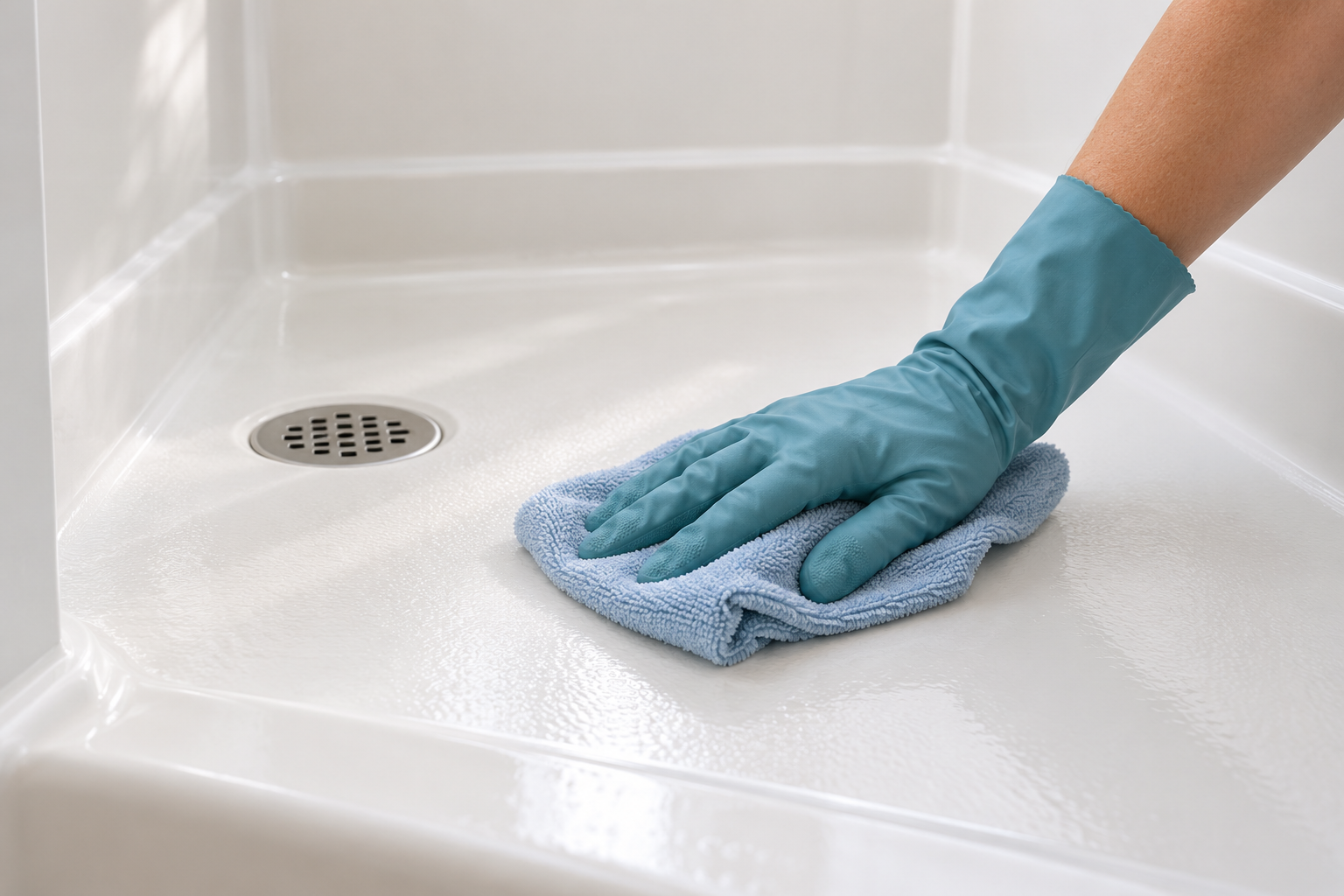
AI-generated illustration, not an actual cleaning photograph or product test.
4. Wipe gently and follow the stated timing
Apply only as directed and wipe with the soft cloth. There is no universal five-, ten-, or thirty-minute soak for shower floors. Follow the permitted contact time and any immediate-rinse requirement. If the cleaner needs a treatment the base maker prohibits, select another approved option instead of compromising between incompatible directions.
This method does not prescribe a brush. Aquatic’s maintenance page includes both soft-brush stain directions and a warning against scrubbing the floor. That makes model-specific clarification preferable to treating toothbrush-soft bristles as blanket permission.
5. Rinse, dry, and decide whether to stop
Rinse away the cleaner according to its label and the base instructions, including around the drain edge. Wipe dry with a clean cloth. Do not leave a cleaner layer as a supposed protective coating. If the appearance improves, maintain the gentler routine. If it does not, avoid repeating progressively harder passes.
If the soap scum will not come off
Film appears only after cleaning: Recheck dilution, application amount, and rinsing. Use the prescribed amount rather than assuming extra detergent improves the result. If plain water removes it, revise the cleaning routine before buying a stronger product.
White crust or a stubborn ring remains: Mineral deposits are another possibility, not a visual diagnosis. Aquatic lists separate treatments for calcium and lime deposits, while MAAX has its own stain guidance. Those permissions are product-specific. This nonabrasive method does not add vinegar, acid descaler, bleach, or a solvent as an automatic second step.
The area looks dull, scratched, chipped, or unlike the surrounding finish: Stop treating it as removable soap. Send the maker or refinisher the model number, photos, and the names of products already used. Ask whether the surface needs a different cleaner or a repair assessment. Do not sand, polish, wax, or recoat the floor to hide the mark.
For texture-focused cleaning after you have confirmed material and tool compatibility, see our textured shower floor guide. Its broader discussion is not permission to override your particular base’s care instructions.
Safety: one product, no homemade combinations
Ventilate the room, follow protective-equipment directions, and keep children and pets away during cleaning. Never mix cleaning products. Poison Control explains that bleach combined with acids can release chlorine gas, while bleach with ammonia can produce chloramine gas. Do not add vinegar or another cleaner to a bottle or bucket containing a previous product.
If fumes cause irritation, leave the area immediately for fresh air. For exposure advice in the United States, call Poison Control at 1-800-222-1222. Seek urgent medical care for trouble breathing or other serious symptoms. Do not remain in the bathroom to finish rinsing when fumes are affecting you.
AI-generated illustration, not an actual cleaning photograph or product test.
Prevent another layer of residue
AKER recommends wiping its tub and shower surfaces after every use with a squeegee or soft cloth to reduce buildup from soap, bath additives, body oils, and minerals. Use a soft cloth where a squeegee cannot follow the floor shape. Keep the drying routine gentle and avoid standing on a slippery wet base.
Remove mats as your manufacturer directs; Aquatic says to remove rubber or plastic anti-skid mats after every shower. Never use wall-polishing advice on the standing surface: Bestbath excludes cleaner wax from its shower pan, and AKER warns against waxing shower bottoms because they can become slippery. Our surface cleaning guide can help organize care instructions for other bathroom materials.
FAQ
Can I use dish soap on a fiberglass shower floor?
Only when the applicable care guide permits it. Bestbath recommends liquid detergent, Aquatic lists liquid detergents, and MAAX specifically includes dishwashing soap in its maintenance guidance. Follow the product’s directions and rinse thoroughly; do not invent a stronger dilution.
Is a melamine sponge a nonabrasive substitute?
Do not assume it is an approved substitute for a soft cloth. This method leaves cleaning erasers out. MAAX specifically prohibits them for its Utile panels, but that panel instruction should not be generalized into a claim about every shower floor.
Will a nonabrasive cleaner restore a dull finish?
Not necessarily. Removing residue and repairing a finish are different tasks. If rinsing and approved gentle cleaning do not change the mark, ask the manufacturer before trying restoration products.
Sources
- Bestbath: Cleaning & Maintenance
- Aquatic: Product Maintenance
- MAAX: Product Maintenance
- AKER: Product Maintenance
- Poison Control: Chlorine gas
Last reviewed: 2026-10-23. Based on the manufacturer and safety guidance linked above, not hands-on product testing. Follow current instructions for your exact shower finish and cleaner.