Short answer: For ordinary reusable microfiber hard-surface wiping cloths that streak or collect lint, check the care label before trying a separate wash without softener or dryer sheets. This guide summarizes manufacturer sources; our team has not tested this reset. It excludes upholstery, lens or screen cloths, and high-risk contamination. Stop using a cloth on delicate finishes if it contains trapped grit, is torn, or feels hardened, and check the manufacturer’s advice.
The stock photograph above shows a gloved hand holding a cloth against tile; it illustrates wiping, not a laundry procedure or a result from our team. A cloth that looks clean in a photograph can still require a check of its label and care history. Appearance alone cannot identify why a cloth streaks. Laundry residue and transferred lint are possibilities worth checking, alongside the surface and cleaning product. Work through the steps below in order and change one thing at a time so you can tell what actually helped.
Read the care label before you change anything
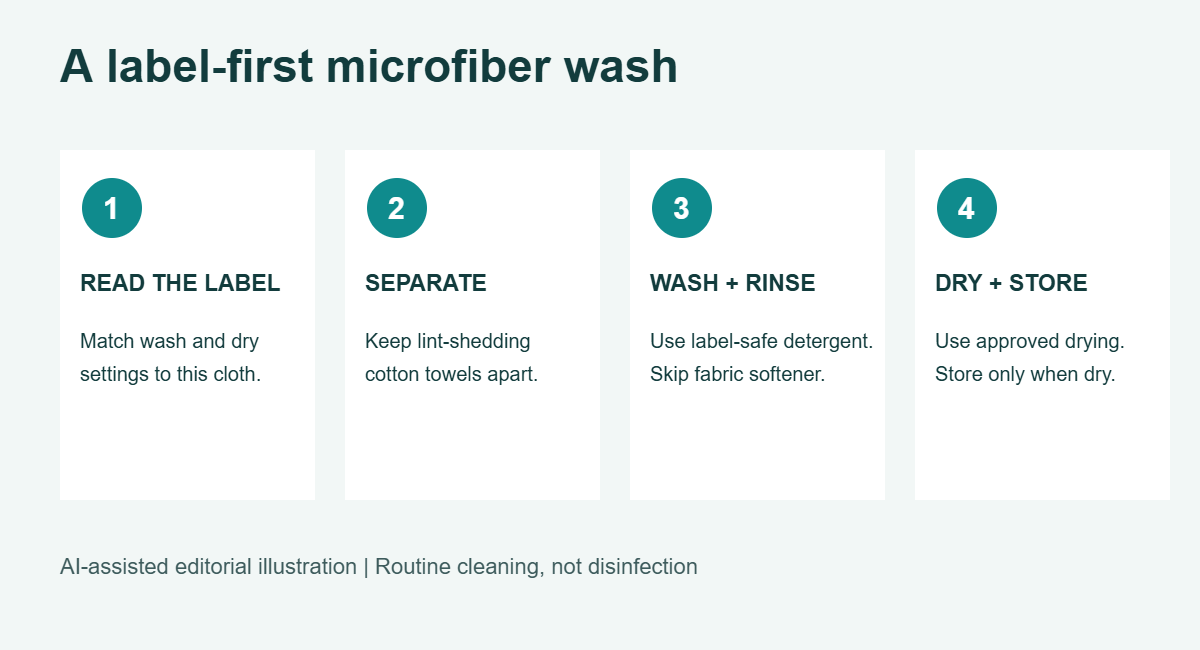
Microfiber is made from fine synthetic fibers, including polyester and sometimes nylon, and manufacturers wash it differently depending on how the cloth is built. Arm & Hammer’s guidance is explicit that you should follow the instructions on the manufacturer’s garment care label for the wash cycle and temperature. That matters here because two reputable manufacturers do not give identical steps, and the label on your specific cloth is the tie-breaker.
So before anything else, find the care tag or the packaging the cloths came in. Note the recommended temperature, whether a dryer is allowed and at what heat, and whether the cloth is described as bleach safe. If the care label and packaging are missing, look up the exact cloth’s instructions or ask its manufacturer before choosing a wash cycle, water temperature, or drying method. A missing label does not establish that the cloth is machine washable.
Wash microfiber on its own
Both sources recommend washing microfiber separately to reduce lint pickup; neither establishes that this step fixes most streaks. Microfiber is extremely absorbent and grabs onto loose fibers, so washing it with cotton towels or regular laundry loads it up with lint that later smears across glass and tile. Arm & Hammer recommends washing microfiber items separately so they do not pick up lint, hair, and dust from other items. Rubbermaid Commercial’s facility guidance makes the same point, noting that cotton sheds lint that clogs the fibers and that a microfiber-only wash helps keep a streak-free finish on glass, mirrors, and polished surfaces.
So gather microfiber into its own load. If you only have a few cloths, it is still worth running them together rather than adding them to a mixed wash. Shaking or rinsing loose debris out of the cloth before it goes in also helps, so the dirt leaves with the wash water instead of settling back into the fibers. This is a different problem from cotton towels that smell sour after washing, which is usually about moisture and odor rather than lint transfer, so do not assume the same fix applies to both.
Detergent, and what to leave out
Residue is one possible contributor to streaks. Arm & Hammer recommends a mild detergent without perfumes or dyes, because those additives settle into the fibers and make the cloth less effective at cleaning and drying. Rubbermaid’s commercial guidance is stricter in the same direction: a fragrance-free, additive-free liquid detergent, and specifically no powder, no fabric softener, and no scented products, because they leave residue that stops the cloth lifting dirt.
The clearest shared rule across both: skip fabric softener and dryer sheets entirely. These products can coat the fibers or reduce cleaning performance; their use does not prove the cause of a particular streak. Too much detergent is its own source of buildup, the same way detergent can build up in a washer drawer. Follow the detergent package and washer instructions for the actual load, soil level, water conditions, and machine; this guide does not prescribe a universal teaspoon dose.
Water temperature: why the two labels disagree
Here the sources genuinely differ, and it is worth being honest about that rather than inventing one universal rule. Arm & Hammer suggests cold water for lightly soiled microfiber and warm water for heavily soiled items, always on a gentle or delicate cycle, while deferring to the care label. Rubbermaid’s commercial routine calls for warm water as the default to break down grease and grime on a short cycle. Rubbermaid explicitly warns against hot water because it can shrink fibers or weaken cleaning performance. Arm & Hammer specifies cold or warm water according to soil level and defers to the care label; it does not explicitly prohibit hot water.
Use the cloth’s documented care instructions to choose the cycle, temperature, and drying method. Arm & Hammer describes gentle or delicate washing with cold or warm water according to soil level; Rubbermaid’s commercial guide uses warm water and a short or gentle cycle. These are source-specific recommendations, not proof that every microfiber product permits the same settings. If your cloth’s instructions are unavailable, confirm them with its maker before washing.
Drying and finishing the load
High dryer heat can damage microfiber. Both sources advise low heat only, and never fabric softener or dryer sheets. Arm & Hammer adds emptying the lint trap first and skipping dryer balls. Rubbermaid warns that microfiber is heat-sensitive and can shrink or even melt at high temperatures, and recommends line drying or a rack in a clean, dust-free spot when possible. Use a low dryer setting or rack drying only if your cloth’s instructions allow it; air drying away from lint-shedding fabrics is a cautious option when you are not sure of your dryer’s low setting.
One detail where the two differ on hand washing: Arm & Hammer describes wringing the cloths out, while Rubbermaid says not to wring or twist and to press the water out gently instead. Again, do not treat either as the universal rule. If your cloth’s label or packaging says anything about wringing, follow that; otherwise pressing water out is the gentler default.
Complete the rinse so detergent is removed, following the washer and cloth instructions. Once drying is complete, store the clean cloths dry and apart from used cloths and lint-shedding fabrics.
This AI-assisted editorial table summarizes source guidance; it does not diagnose a cloth or replace its care instructions.
AI-assisted editorial table
| What you see | Possible contributor, not a diagnosis | First check | Action within the label |
|---|---|---|---|
| Fine lint on the surface | Lint picked up from another item, including cotton laundry | Check washing and drying companions and inspect for trapped debris | If the label permits washing, wash microfiber separately and shake out loose debris first |
| Hazy or greasy-looking streaks | Laundry residue, surface residue, or too much cleaning product | Review detergent, softener, dryer sheets, and surface-product use | Follow cloth and product labels; omit softener and dryer sheets and rinse fully |
| Reduced water pickup | Residue or possible fiber damage; appearance alone cannot distinguish them | Check care history and the manufacturer’s instructions | Try only a label-permitted wash; do not escalate heat or chemicals if performance remains poor |
| Torn, hardened, or persistently flattened fibers | Possible physical damage or residue; matting alone does not prove irreversible wear | Inspect for tears and trapped grit; ask the maker if condition is unclear | Keep suspect cloths off delicate finishes; replace confirmed damaged cloths rather than promising wash restoration |
When streaks mean something other than laundry
Not every streak is a laundry problem. If the cloth is clean and freshly reset but still smears, look at what you are wiping and with what. A product film on the surface itself, or too much spray left sitting, can streak even a perfect cloth. For hard surfaces, our surface cleaning guide covers matching the approach to the material. Washing cannot repair torn fibers, but reduced pickup or matting alone does not prove permanent damage. If a label-permitted wash does not help, check the surface and cleaning product and ask the cloth manufacturer before deciding whether to replace it.
A note on bleach and disinfection: Rubbermaid’s guidance allows bleach only when the cloth’s own label confirms it is bleach safe, and that advice sits inside a commercial, high-risk-contamination context. For ordinary home wiping cloths, that is not a step to borrow casually. Do not reach for bleach, vinegar soaks, boiling, or any DIY mixture to “fix” streaks. None of that is in either manufacturer’s streak-and-lint routine, and some of it can damage the fibers. If a cloth truly needs disinfecting for a health reason, that is a separate decision driven by the label, not part of this reset.
Where to start, and the next step
Start by finding the cloth’s care instructions and checking whether its last load included cotton, softener, or dryer sheets. Change only one permitted part of the routine, rinse and dry as directed, then check performance on a small suitable area. Stop escalating if the result is unclear.
Frequently asked questions
Can I just rewash the same cloths and expect the streaks to stop? A label-permitted rewash may help when lint or laundry residue is involved, but it is not a guaranteed fix. Wash microfiber separately, follow the detergent and cloth instructions, rinse thoroughly, and dry only as allowed. If streaks persist, also check the surface and cleaning product rather than assuming the cloth is worn out.
Do I need a special microfiber detergent? A specialty product is not required by the two general guides cited here, but follow any detergent restriction for your specific cloth. What matters more is what you leave out: softener, dryer sheets, and excess detergent.
Is it safe to tumble dry microfiber? Only on low heat, and only if the care label allows a dryer. High heat can shrink or damage the fibers. Air drying on a rack away from lint-shedding fabrics is a cautious alternative.
Why do my cloths pick up lint even though microfiber is sold as lint-free? Arm & Hammer explains that microfiber itself may not shed much, but its absorbent nature means it pulls lint and hair from other sources. That is exactly why a separate load helps.
Sources
- Arm & Hammer, “Microfiber for Cleaning & Steps for How to Wash Microfiber Towels or Cloths.”
- Rubbermaid Commercial (AU), “How to Wash Microfibre Cloth in Commercial Settings: Best Practices for Longevity and Hygiene” (27 June 2025).
- Illustrative stock photo: Kaboompics / Pexels, photo 4239039.
Author: CleanThisWay Editorial Team. Last reviewed: November 1, 2026. This article summarizes the manufacturer sources linked above; our team has not performed hands-on testing of this reset. The photograph is a stock illustration, not our work or a record of results. The table and step diagram are AI-assisted editorial summaries, not manufacturer instructions or test evidence. Follow the care instructions for your exact cloth.