If a greasy film is clinging to a Sistema KLIP IT food container, warm soapy water is the hand-washing method Sistema’s use-and-care guidance allows, with no abrasive cleaners, scrubbers, or sharp tools. Two limits also matter: only remove a seal the maker designs to come out, not one on an unknown container, and if a film will not shift or you see damage, stop and check with the maker instead of scrubbing on.
What you might notice
People describe a greasy film in different ways, and a slippery feel is one of them; what you observe is a starting point, not a diagnosis of the surface. Sistema’s guidance is to wash containers with warm soapy water rather than water alone, which is the manufacturer’s stated method rather than a claim we are making about why a rinse falls short. If a film also seems to hold an odor, our household odor guide covers where kitchen smells can come from, without assuming any single cause in your case.
What Sistema’s guidance allows
According to Sistema’s use and care guidance, warm soapy water can be used to wash KLIP IT containers, and for a thorough clean the flexible seal should be removed from the lid and washed separately. That makes hand washing a reasonable first choice, because you can reach the sealing groove and the corners directly. Sistema describes the water only as warm and soapy and does not give a temperature, a soak time, or an amount of detergent, so follow the container’s and the detergent’s own labels rather than inventing numbers of your own.
What to gather first
Sistema’s guidance says not to use abrasive cleaners or scrubbers, because they can dull the surface, and to keep sharp tools away because they could scratch or scuff it. Working within those limits, a soft cloth or a non-abrasive sponge is our editorial pick rather than an item Sistema names, alongside warm soapy water and a rack or clean towel for drying. Leave steel wool, scouring pads, and knife tips out of the job. For a broader look at what is safe on different kitchen materials, our surface cleaning guide is a starting point you can return to.
A gentle step-by-step wash
The order below is our editorial sequencing; the seal-removal and drying points come from Sistema’s own instructions, while the rinses are ordinary steps rather than manufacturer quotes. Touch and appearance along the way are reference cues, not proof that a surface is clean or safe to hold food.
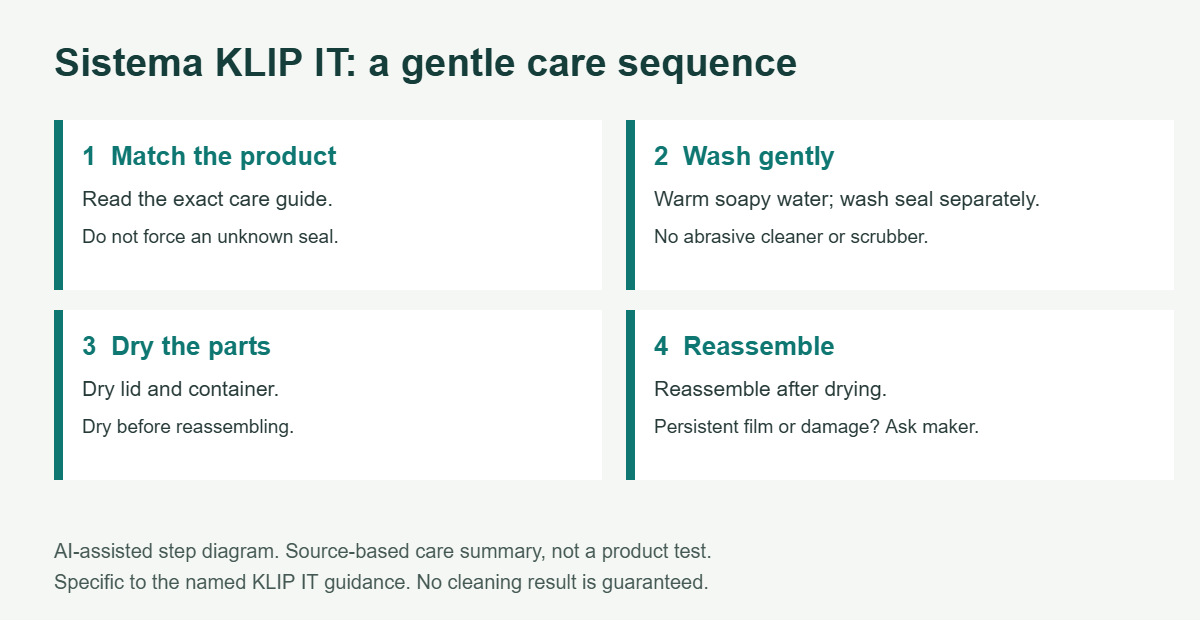
The first thing to settle is matching the container to its own care guide, and not prying out a seal that the maker does not intend to come off. From there the idea is to wash gently, dry the parts, and reassemble only once they are dry. That sequence is about using the right instructions and avoiding damage, not about guaranteeing any particular result.
- Separate the parts. Unclip the KLIP IT lid and remove the flexible seal from it. Sistema calls for washing the seal separately for a thorough clean, so aim to have the base, the lid, and the seal as three pieces before you wash.
- Rinse loose residue. Hold each part under warm running water to carry away loose food. This is an ordinary first rinse, not a step from Sistema’s wording.
- Wash with warm soapy water. Using a soft cloth or non-abrasive sponge, work soapy water over the walls, into the corners, and along the sealing groove. Do not press harder or keep washing endlessly if a film stays behind; a film that will not shift is a sign to check with the maker, not to scrub.
- Rinse off the suds. Rinse each piece under warm water until no soapy residue is visible on the base, the lid, or the seal.
- Dry before reassembling. Set the base, lid, and seal on a rack or towel. Sistema says to dry the lid and container before putting them back together, so once each part is dry, refit the seal into the lid.
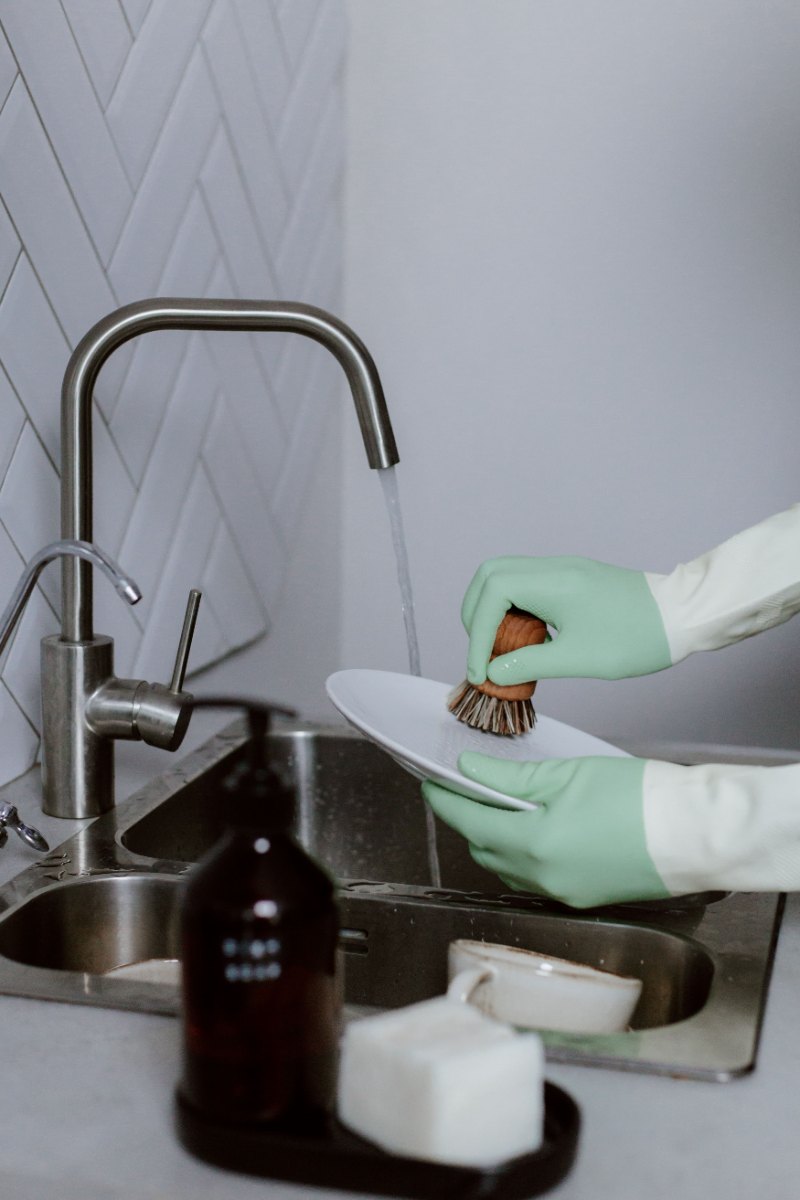
The stock image here shows green-gloved hands using a wooden brush on a white plate at a metal sink, as a general kitchen example rather than this container. It is not a Sistema KLIP IT, and it does not stand in for the tools you should use. For the KLIP IT, the soft-cloth and non-abrasive approach above is what fits Sistema’s warnings.
KLIP IT versus Rubbermaid Brilliance: what each maker actually says
If you own more than one brand, it helps to know that use-and-care instructions differ from maker to maker. The table below compares Sistema’s KLIP IT guidance with Rubbermaid’s guidance for its plastic Brilliance line. It is an AI-assisted editorial comparison drawn from each maker’s published pages, not a lab test, and the glass Brilliance range carries its own separate instructions that do not transfer to the plastic version.
AI-assisted editorial table: manufacturer guidance compared
| Topic | Sistema KLIP IT (plastic) | Rubbermaid Brilliance (plastic) |
|---|---|---|
| Hand-wash water | Warm soapy water stated for washing containers | Says to wash before use; no specific hand-wash tool, soak, or detergent detail in this source |
| Seal or gasket | Remove the flexible seal from the lid and wash it separately | No seal-removal instruction in this source |
| Abrasives | Avoid abrasive cleaners and scrubbers, which can dull the surface | Not specified in this source |
| Sharp tools | Keep away; they could scratch or scuff the surface | Advises against knives, which can scratch or cause wear |
| Dishwasher | Top rack only, away from the heating element | Dishwasher safe; keep away from the heating element; no top-rack restriction stated |
| Reheating note | Reheat precooked food with the lid removed; do not reheat food high in salt, oil, fat, or sugar, which can cause severe damage; tomato, curry, turmeric, or beet can stain | Microwave with the latches open; not intended for cooking; do not reheat food high in oil, fat, salt, or sugar, which can cause severe damage |
| Staining | High-fat and high-sugar foods can stain during reheating | Marketed as stain-resistant, which is not the same as stain-proof |
Because Rubbermaid’s page does not spell out a hand-washing tool, soak, or seal routine, treat it as general care rather than a grease-cleaning method; you can read it in full on Rubbermaid’s use and care page. The practical takeaway is that the detailed hand-wash and seal steps in this guide come from Sistema’s own instructions for the KLIP IT, not from the Rubbermaid page.
What the makers tell you not to do
A few warnings from the makers are worth keeping in front of you while you work:
- Skip abrasive cleaners and scrubbers on the KLIP IT; Sistema says they can leave the surface dull.
- Keep sharp tools away, since Sistema says they could scratch or scuff the surface.
- Only remove the seal that Sistema designs to come out of the KLIP IT lid. Do not pry at a fixed gasket on a different container just to clean behind it; a bottle gasket, for example, follows its own removal steps, which our water bottle gasket guide covers for that product rather than this one.
- Both makers warn against reheating food that is high in salt, oil, fat, or sugar, because it can cause severe damage to the container; that is a food-reheating limit, and this guide is about washing, not reheating.
- Do not turn reheating rules into a cleaning method. Sistema’s lid-off reheating guidance and Rubbermaid’s latches-open note are about warming food, not about washing, so they are not a license to boil or heat the container clean.
- If you use a dishwasher, Sistema limits the KLIP IT to the top rack, away from the heating element, so the parts are not sitting next to the hottest spot.
When to stop and check with the maker
After drying, you can look at and feel the surface, but treat what you notice as reference symptoms rather than a diagnosis or a food-safety verdict.
- A surface that still feels slippery or oily may mean a film remains. Rather than scrubbing harder, this is a point to pause.
- An orange, yellow, or brown tint on a surface that feels clean is a discoloration you can see; Sistema notes foods such as tomato, curry, turmeric, and beet, along with high-fat and high-sugar foods, can stain during reheating, and Rubbermaid markets its line as stain-resistant, which is not the same as stain-proof.
- Dullness, cloudiness, scratches, or warping are changes to the surface itself.
None of these tell you on their own whether a container is restored or fit to hold food again. If a film will not shift, or you see possible damage, do not return the container to food use before checking: contact Sistema, or Rubbermaid for a Brilliance item, with your model and a photo and ask whether the container is still suitable.
Your next step
Pick one action based on what you observed. If the parts came free of loose soil and soap and you have no concerns, dry them fully and refit the seal last. If a film will not shift, or you see discoloration or damage you are unsure about, set the container aside and contact the maker with the model and a photo before using it with food again. That keeps the decision about whether it is safe to reuse with the manufacturer, not with a surface you cannot fully judge by eye.
Sources
- Sistema, Use and Care (KLIP IT): sistemaplastics.com/us/useandcare
- Rubbermaid, Brilliance Use & Care Instructions: help.rubbermaid.com
- Photo: Ron Lach / Pexels, photo 10573233 (free stock illustration): pexels.com
By the CleanThisWay Editorial Team. Last reviewed November 2, 2026. This is a manufacturer-source desk guide compiled from published use-and-care pages, not a hands-on product test.