Short answer: routine vacuuming and wet cleaning are separate decisions, and your mattress’s care label and manufacturer decide what each allows. Where the label permits it, routine care is gentle, low-suction vacuuming with an upholstery attachment, which alone never authorizes wet cleaning. Do not add water, detergent, bleach, or steam if the label prohibits it, if the instructions are missing or unreadable, if the fabric or seams are damaged, or on a material the maker says must stay dry; Tempur-Pedic says TEMPUR-Material must never get wet, and Serta advises against applying liquids.
Stop and step back if the fabric loses color, the texture changes, a seam starts to open, or a mark is large, old, or strong smelling, and ask the manufacturer or a professional. This guide explains how routine vacuuming differs from wet or steam cleaning and how to decide, from that guidance, what belongs on a fabric-covered single mattress. It is a manufacturer-source information guide, not hands-on testing by our team.
Routine vacuuming, wet extraction, and steam cleaning are different
Routine vacuuming lifts dust, lint, and debris using airflow alone and adds no moisture. Wet or hot-water extraction is different: it applies liquid to the surface and then draws some of it back out. Steam cleaning is different again: it applies heat and moisture to the fabric. Because a mattress holds layers that are slow to dry, anything that adds moisture carries risks a dry vacuum pass does not.
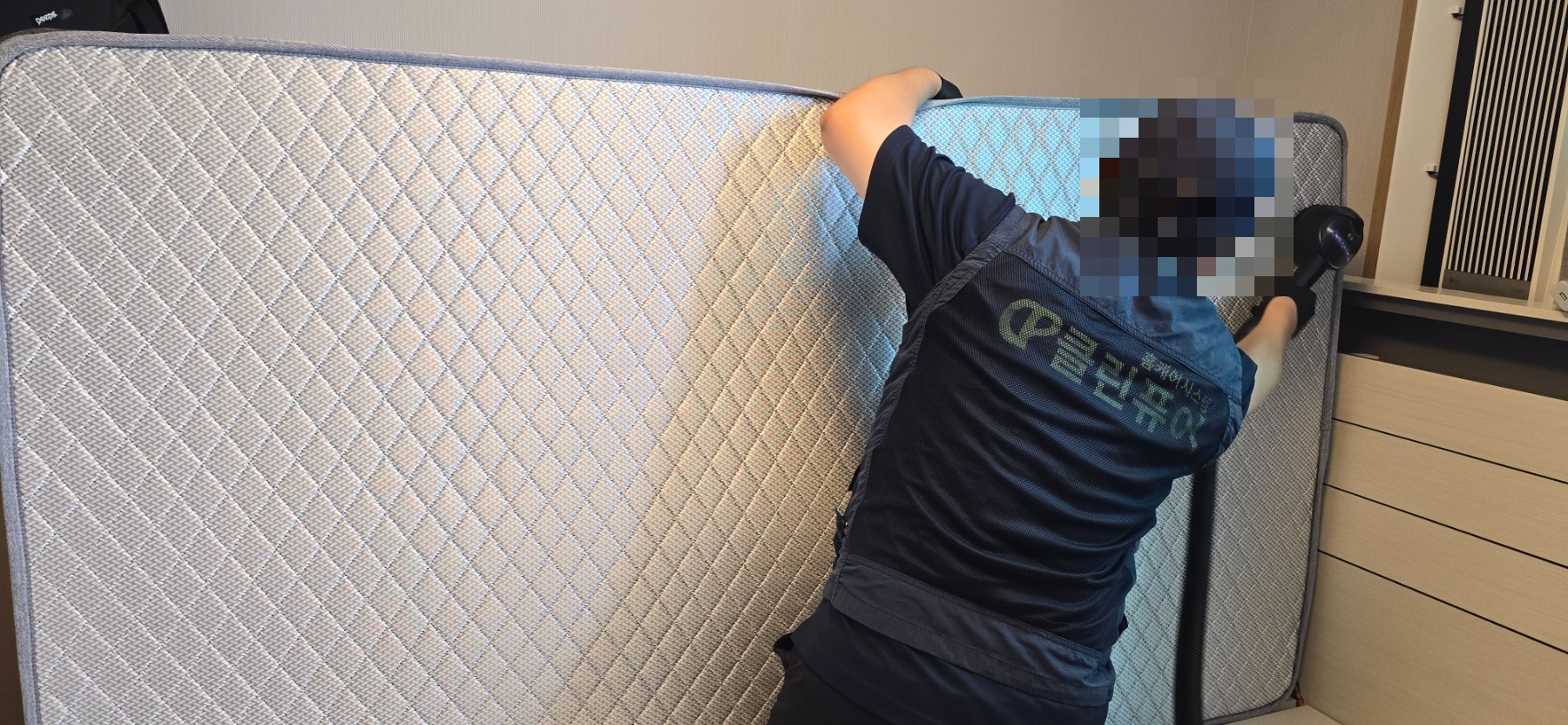
The photographs were supplied by the company that owns them and holds usage rights, shown as documentation only, not a recommendation to wet-clean your mattress. The supplied facts are limited to a Daegu, South Korea apartment, a single mattress, and a dry vacuum followed by a wet extraction step; 2026-08-04 is a folder-reference date, not a verified job, photo, or test date. This frame shows the broad diamond-quilted face of an upright single mattress, with a worker (head covered by a mosaic) holding a handheld tool near its upper edge. It does not reveal the model, care label, or which step is underway.
Start with the care label and the manufacturer’s permission
Before any tool touches the fabric, find the care label or model-specific instructions and read what they permit. A quilted surface or a zippered cover does not tell you whether vacuuming is advised, let alone whether water, detergent, or steam is allowed.
Sealy Australia describes routine care as vacuuming with an upholstery attachment on low suction, using slow, gentle passes. It says to avoid detergents, bleach, and dry-cleaning chemicals unless your product’s care instructions specifically state otherwise, and, as a separate caution, not to use a wet vacuum, carpet cleaner, or steam cleaner unless advised to do so, warning that steam adds heat and moisture. Read those as narrow, product-specific exceptions, not a green light or permission to disregard a manufacturer’s prohibition.
A safe, care-label-first vacuuming flow
For a mattress whose label allows it, keep the routine dry and gentle. You need only the care label and a vacuum with an upholstery attachment the label allows, not detergents, sprays, or a wet or steam machine.
- Strip the bedding and inspect. Remove sheets, protector, and toppers, launder them by their labels, and check the surface and seams; if the fabric is torn or a seam is open, seek advice before vacuuming.
- Confirm the label allows vacuuming, then use low suction. With an upholstery attachment, Sealy Australia recommends slow, gentle passes without pressing too hard; stop if the fabric snags or drags on a worn area.
- Work the whole surface and the seams. Move over the panel and along the piping and edges, keeping contact light.
- Do not add anything wet. If the mattress seems to need more than vacuuming, check the care label and the maker’s guidance; if it prohibits moisture or you cannot confirm it is allowed, stop there.
- Refit bedding only when dry. After any spot cleaning the label specifically permits, let the surface dry fully before a protector or sheet goes back on.
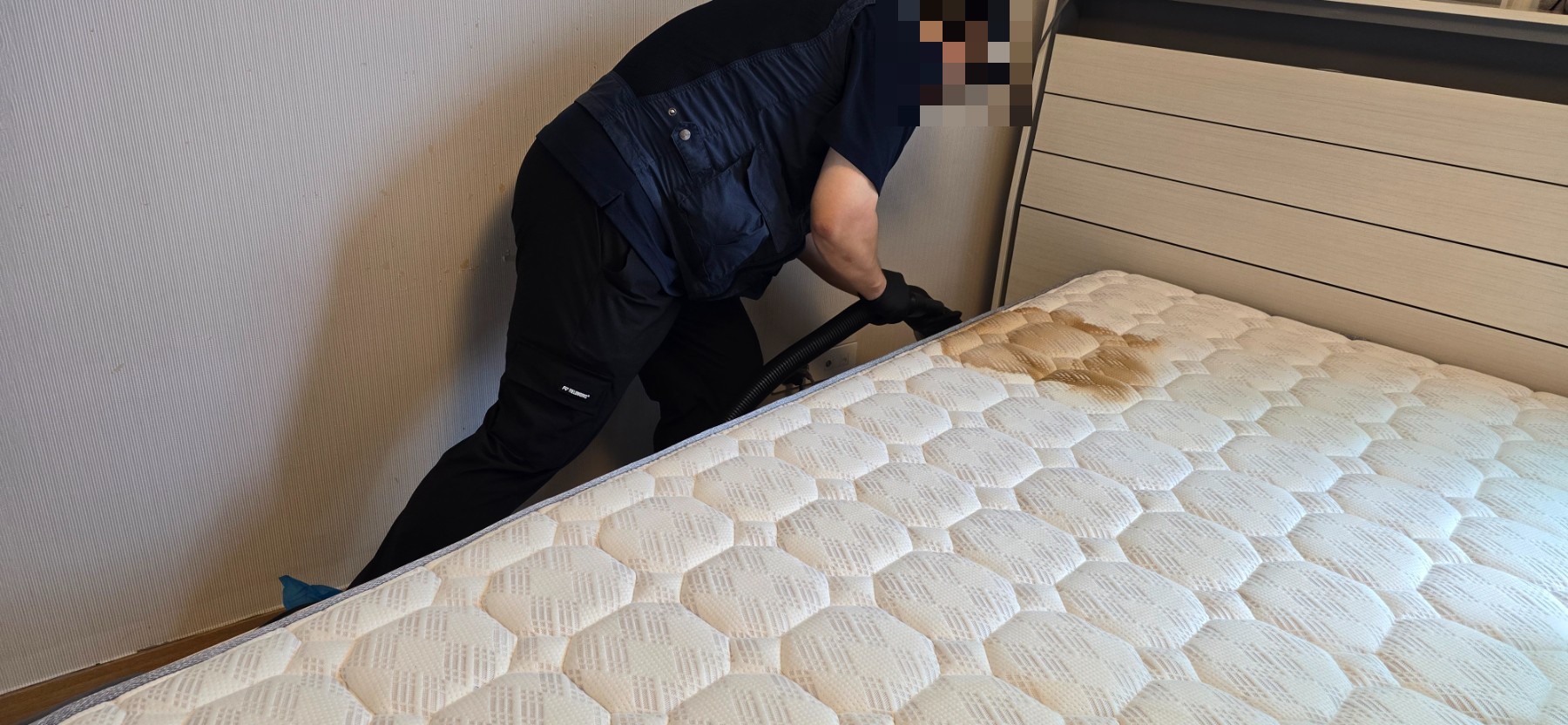
Here a worker (head covered by a mosaic) holds a hose and nozzle near the edge of a white honeycomb-quilted single mattress, and a brown discolored patch is visible nearby. The still image does not reveal what caused the patch, what the tool is doing, or whether anything was removed, and it is not a before-and-after comparison.
What these photographs can and cannot show
No written notes or memo accompany these images; the only supplied description is the location and sequence above, and nothing documents the model, products, methods, approvals, or results. Because the care label and model are unknown, there is no basis to say wet extraction was appropriate here, and nothing should be read as endorsing it for yours.
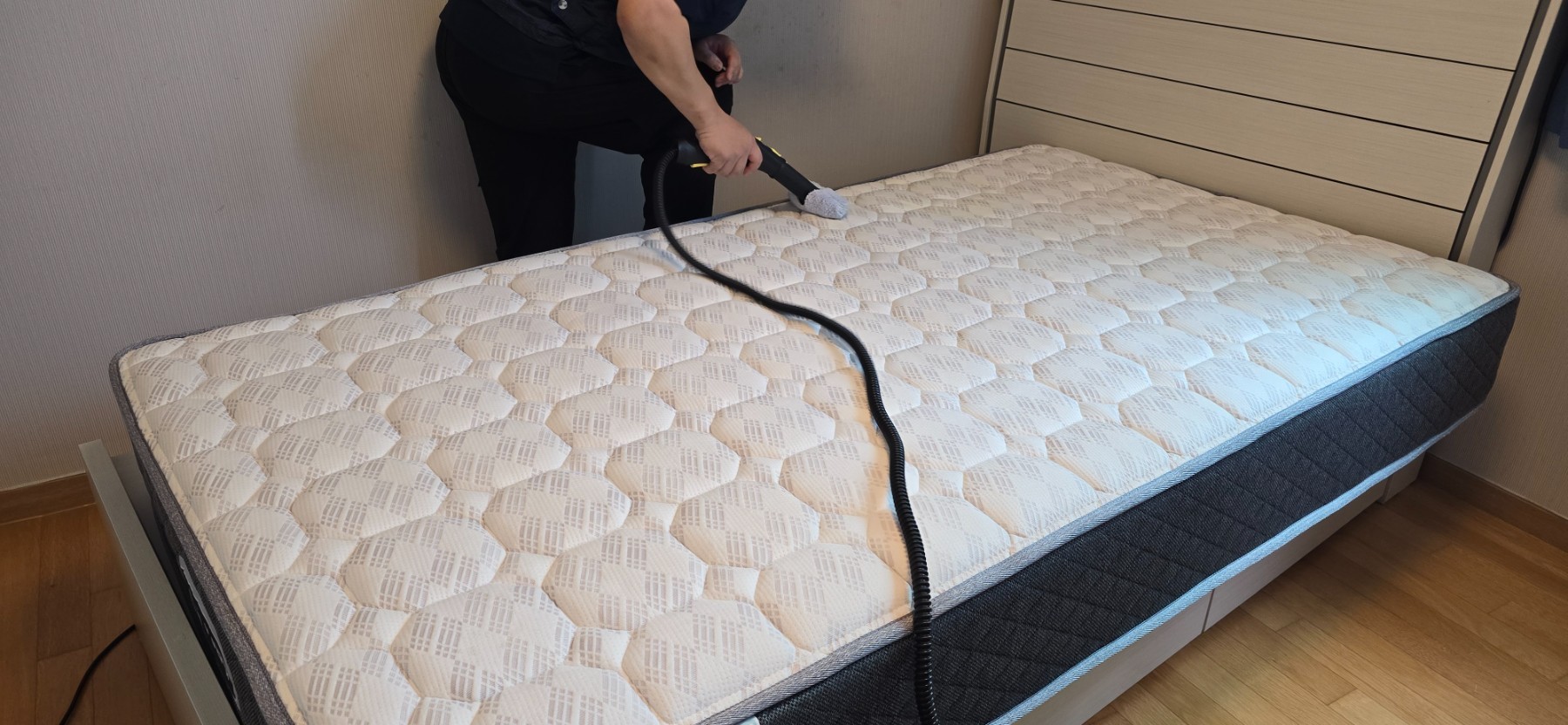
This closer frame shows a handheld tool with a flexible hose held against the quilted fabric by a worker whose head is above the top of the frame. The still image does not show whether any liquid, heat, or suction is involved, so it is not called steaming or extraction or given a temperature, and it shows nothing about how much was removed, the fabric’s condition afterward, or how long anything took to dry.
Manufacturer guidance differs by brand
The pictured mattress is not identified as a Sealy, Serta, or Tempur-Pedic product, so the following shows how instructions vary; each maker’s label governs its own product. Serta advises against applying liquids, warning that moisture or chemicals applied directly can cause premature foam breakdown and damage. Tempur-Pedic says TEMPUR-Material should never be soaked, washed, or allowed to become wet, and that a removable, washable cover may be cleaned only by its own product tag, not as blanket permission for every cover. That no-wet rule is specific to TEMPUR-Material and does not automatically apply to an unidentified memory-foam mattress. Because much of Sealy Australia’s advice is region- and product-specific, it should not be applied to every US mattress. Where an official manufacturer prohibition exists, it outranks any example photo.
When to stop and get help
A remaining mark, a lingering smell, and visible damage are different problems, and repeating a cleaning is not a reliable fix for all three. Route a large, old, or strongly odorous mark to the maker’s customer care or a professional cleaner.
A concise decision table
| Your situation | Safe starting step | Stop and get manufacturer or professional input |
|---|---|---|
| Routine freshening, no spill, label allows vacuuming | Low-suction upholstery vacuum, slow gentle passes | If the fabric is damaged or the label prohibits vacuuming |
| Care label missing or unreadable | Try to identify the model and its care guidance; keep to gentle, dry handling meanwhile | If safe care cannot be established, ask the maker before vacuuming hard or adding any liquid |
| TEMPUR-Material (Tempur-Pedic) mattress | Follow the Tempur-Pedic care label and keep the material dry | TEMPUR-Material should never be soaked, washed, or wet |
| Other or unidentified foam mattress | Follow that mattress’s own maker and label | Do not assume the TEMPUR no-wet rule or any one brand’s rule applies |
| Removable cover you think is washable | Confirm removal and washing on that cover’s own label first | Do not assume every zippered cover is machine washable |
| Large, old, or strong-smelling mark | Document it and seek advice | Contact the maker or a professional before any home wet cleaning |
Maintenance between cleanings
Sealy Australia suggests vacuuming the surface every three to six months, and notes that homes with pets, children, warm sleepers, or allergy-sensitive sleepers may need more frequent care, washing bedding and protectors more often. Separately, it ties climate to ventilation: good airflow and a suitable bed base rather than the floor help limit trapped moisture in humid conditions. These are routine freshness steps, not promises about dust mites or hidden buildup.
With a spill, the decision shifts to whether any treatment is allowed. Our stain removal guide explains how to start from the material and its instructions rather than the look of the mark, and our guide to machine-washing sofa cushion covers shows why a zipper alone does not authorize laundering.
Key takeaways
- Vacuuming and wet or steam cleaning are separate decisions set by the mattress’s own label and maker; routine vacuuming never authorizes wet cleaning.
- Manufacturer prohibitions, such as Tempur-Pedic’s no-wet rule for TEMPUR-Material, outrank any example photo, and one brand’s rule does not transfer to another product.
- The case photographs are documentation only, with an unknown model and care label, and cannot show cause, phase, results, moisture, or drying.
FAQ
Does vacuuming a mattress mean I will need to wet-clean it too?
No. Vacuuming is a dry maintenance step. Wet cleaning is a separate decision that depends on your care label and the manufacturer’s permission.
Can I steam clean my mattress to go deeper?
Not unless your manufacturer allows it. Sealy Australia warns against steam cleaning many mattresses because of the heat and moisture, and Tempur-Pedic says its material should never get wet. Check your label first.
What if my mattress has no readable care label?
Try to identify the model and its care guidance, keep to gentle dry handling, and contact the maker before adding any liquid; if you cannot establish safe care, ask before going further.
Editorial note and review
Prepared by the CleanThisWay editorial team as a manufacturer-source information guide. Sources were read and this article reviewed on 2026-10-28. No hands-on mattress testing was performed, and no professional credentials are claimed. The photographs are company-owned documentation; 2026-08-04 is a folder-reference date, not a verified job, photo, or test date, and the model and care label are unknown, so the images show observed activity only and do not establish that wet extraction was appropriate for that mattress or yours. Always follow your own mattress’s care label and the manufacturer’s instructions.
Sources
- Sealy Australia: How to clean a mattress (read 2026-10-28)
- Serta: How do I clean my mattress? (read 2026-10-28)
- Tempur-Pedic: How do I clean a spill on my mattress? (read 2026-10-28)