If onion odor lingers on an intact John Boos wood cutting board after produce prep, the approach is simple and ordered: clean the board with mild soap and water the way Boos describes, dry every surface, and only then consider Boos’s optional lemon-and-salt rub if a smell still remains. Stop and rethink before you start if the board is cracked, splintering, or has deep grooves you cannot clean, or if the smell is sour, musty, or clearly not onion, because those are different problems this guide does not cover.
Is this guide for your board?
This page is written narrowly on purpose. It applies when all of these are true: you can identify the board as a John Boos wood board, it is intact with no cracks or open grooves, and the odor you are chasing came from cutting onions. If you prepped raw meat, poultry, or seafood on the same board, odor is the wrong thing to focus on. The University of Maine Cooperative Extension advises keeping produce boards separate from raw meat, poultry, and seafood boards, so a protein-contaminated surface is a food-safety question rather than a smell question and is outside this guide.
This page also does not cover boards you cannot identify, boards that are coated, varnished, or sealed with a film finish, or other brands with their own care instructions. If you are not sure what you own, follow the maker’s own guidance instead of this one. Extension guidance is also clear that grooves that are hard to clean mean it is time to replace the board rather than deodorize it. As an editorial stop signal, we treat visible cracks or splintering the same way: a reason to stop and reassess, not to keep working on the smell.
What you need
Keep the supply list short and ordinary: mild dish soap, two clean cloths, and a clean dry towel for the cleaning and drying steps. If you reach the optional deodorizing step, add plain table salt and one lemon or lime. That is the whole list. You do not need cooking oil, bleach, vinegar, or any specialty product for an onion smell on an intact board.
A quick decision table
| What you see or smell | Scope/decision | Do this |
|---|---|---|
| Intact Boos board, onion smell after produce preparation | In scope | Clean and dry; consider the optional rub only if the onion smell remains |
| Onion smell remains after cleaning and drying | In scope | Optional Boos lemon-and-salt rub |
| Sour, musty, or unexplained smell | Out of scope | Stop; this guide does not cover it |
| Cracks, splinters, or deep grooves | Stop signal | Stop deodorizing; reassess or replace |
| Raw meat, poultry, or seafood was cut here | Out of scope | Treat as food safety, not odor |
| Coated, varnished, or unknown board | Out of scope | Follow that maker’s instructions |
Treating odor as a cue to find and remove its source, rather than mask it, is the same principle behind our household odor guide: clean the source before you reach for a deodorizer.
Step 1: Clean the board the way Boos describes
Clean the surface with mild soap and water using a clean cloth, as Boos’s cutting-board care guidance describes. Then take a second clean cloth, wet it with clean warm water, wring it out, and use it to wipe the soap off every surface you washed, going edge to edge and over both faces so you are not leaving a soapy film in one spot and bare wood in another.
Two things Boos is clear about: do not soak or submerge the board, and never put it in the dishwasher. Standing water and dishwasher heat are hard on wood. Skip harsh detergents as well.
Step 2: Dry every surface, then check
Dry the board right away with a clean, dry towel, covering both faces and all four edges. Any moisture you cannot towel off should air dry before you do anything else. Boos describes standing the board on its end so air can reach the surfaces rather than leaving one face flat and damp against the counter.
Check for odor only after the board is fully dry. If no onion smell remains once the board is clean and dry, you can stop here. Note that removing a smell is about odor only and does not by itself make a surface safe for raw-protein prep; that is a separate food-safety question covered above.
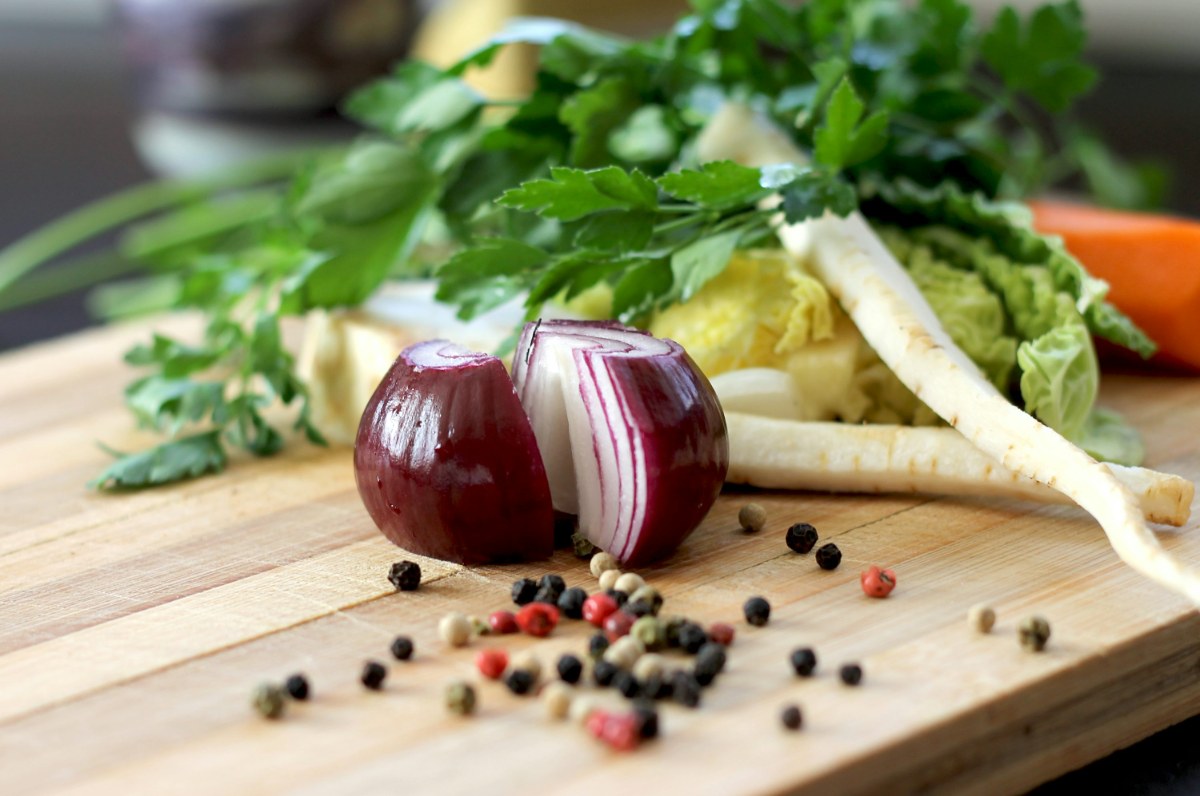
The photo below is a general produce-prep reference showing cut red onion, peppercorns and other vegetables on a wooden surface. It is a stock image, not evidence of the board’s brand, this cleaning process, or any test result.
Step 3: The optional Boos lemon-and-salt rub
If an onion smell is still there after cleaning and drying, Boos describes a specific optional step for onion and garlic odors: sprinkle salt on the board, then rub it with a cut quarter of lemon or lime, squeezing a little juice out as you go, and let it sit for about two to three minutes. After that, wipe the board with a damp cloth and remove the moisture with a clean paper towel, or let it air dry on its end as in Step 2.
A few honest limits. This is an optional, Boos-specific step, not a sanitizing procedure, and it is not guaranteed to erase every trace of smell. Do it only after the board is already clean and dry. Do not mix the lemon or salt with any other cleaner, bleach, or vinegar; the point is a simple rub, not a cocktail. Citrus is acidic, so protect an acid-sensitive countertop by using a separate, compatible work area. Our surface cleaning guide explains why cleaners must match the finish; it is not permission to use citrus on an unidentified counter.
What not to reach for
It is tempting to escalate when a smell is stubborn, but a few common moves work against a Boos wood board. Do not use cooking oils to try to seal in or cover the odor. Do not soak the board, run it through the dishwasher, or scrub with harsh detergents. And do not treat lemon-and-salt as a disinfectant or follow it with bleach or vinegar in the hope of a stronger effect, because that is not what the step is for and it is not a sanitation routine. This article intentionally does not include any bleach or chemical sanitizing procedure, since this is an odor question on a produce board, not a contamination cleanup.
When the smell will not quit
If you have cleaned, dried, and tried the lemon-and-salt rub once and a strong smell persists, the answer is not to keep escalating with stronger chemicals. Stop. A smell that outlasts a proper cleaning may mean the odor is not onion at all, or that the board has grooves or damage holding onto residue, which sends you back to the decision table. At that point, contact John Boos about your specific board, or simply use a different, clean board for the task while you sort it out.
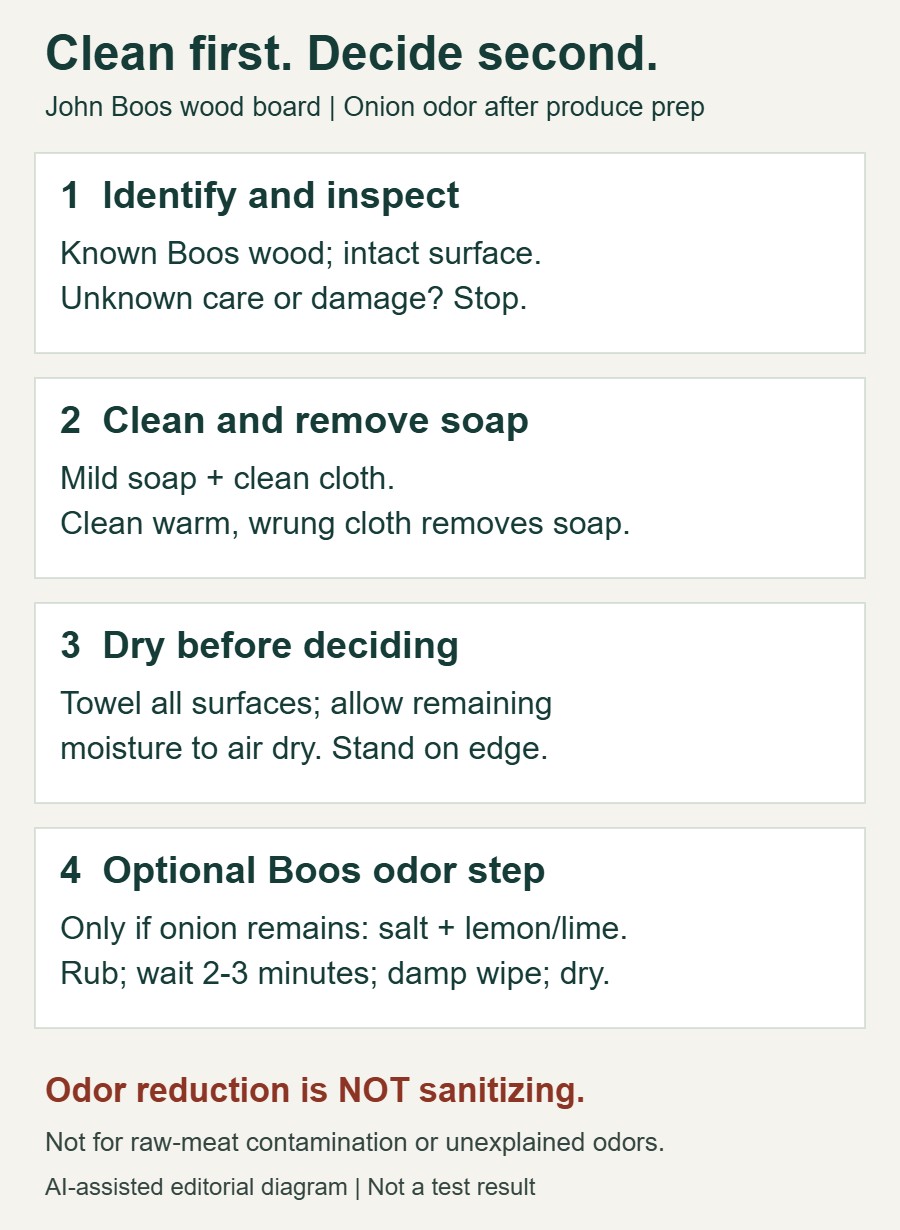
The diagram below is an AI-assisted editorial diagram, not a manufacturer illustration or test result. It lays out the editorial sequence this article follows: first, identify the board and inspect its condition; second, clean with mild soap and remove the soap with a wrung, clean cloth; third, towel-dry and then air-dry; and fourth, use the optional Boos lemon-and-salt rub for about two to three minutes only if an onion smell remains, which is a deodorizing option and not a sanitizing step.
One last note on mineral oil, because it comes up. Food-grade mineral oil is a periodic care step for wood boards, not an odor cure, and it is entirely optional in this odor procedure. If you choose to oil the board with food-grade mineral oil, do it only once the board is completely clean and dry, and follow the product label. Oiling a board to hide a smell is the wrong tool; clean and dry first, decide on odor second, and treat conditioning as a separate maintenance task on its own schedule.
Your one next step: inspect the board’s model and condition, and if it is an intact Boos board with an onion-only smell, follow just that supported branch and clean and dry it first before deciding whether to deodorize at all.
Sources
Photo: Webvilla on Unsplash, used under the Unsplash License.
Last reviewed November 4, 2026. CleanThisWay Editorial. This is a desk guide compiled from manufacturer and extension sources; it was not hands-on tested.